

Carrying Power
In Eric Cross’s The Tailor and Ansty, Timothy Buckley describes a collop as “an old count for the carrying power of land”, noting that it was land deemed capable of supporting the grazing of one cow, six sheep, or twelve goats. He saw it as a better measure of land value than the acre, noting that a holding of 4,000 acres of barren land would barely produce enough to feed four cattle. Powered land sites warrant a similar approach: two sites with almost identical acreage, headline megawatts, and energization dates can have dramatically different carrying power.
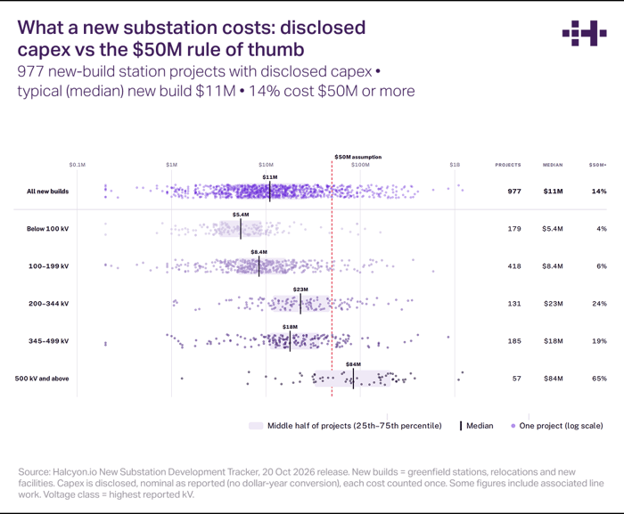
At a recent AI Flexibility Policy Roundtable, a common frustration voiced by members was that critical information about a project surfaced only later in the process. It is challenging in today’s market to compile the necessary information early enough in the development process without risking development dollars or staying away from certain markets altogether. Substation development is a case in point. It is a key complement to interconnection queue data as a signal of grid investment, and often the stage with the longest lead time for a grid-connected project. Across 1,343 projects in Halcyon’s latest substation tracker that report both a construction-start and an in-service year, the median gap between the two is two years. The spread between regions is wide, with a median of two years in PJM versus four years in SPP. Project-level timelines vary even more widely, and the information arrives early, but not immediately (Halcyon).
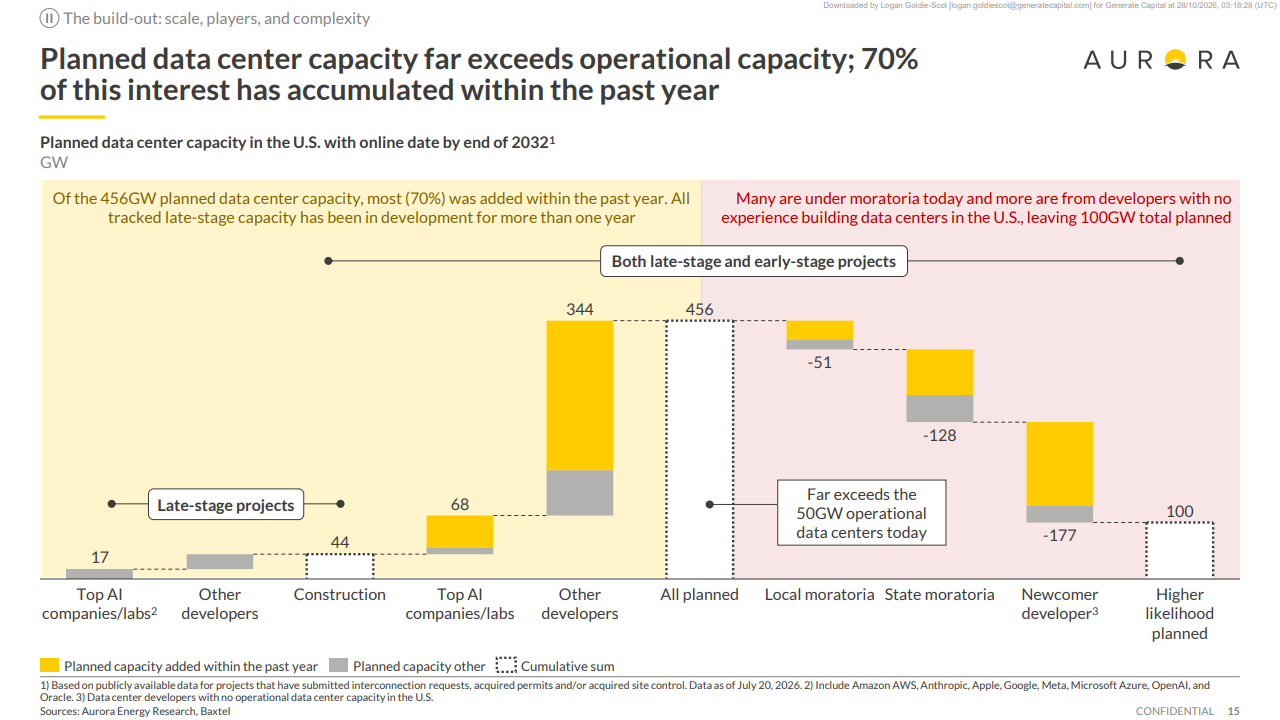
In a market this nascent, there are a handful of experienced incumbents, but it is fluid enough that a track record is no guarantee of future success. Most of the field is new, too: 70% of planned data center capacity has been added in the last year, and 40% of planned capacity comes from new developers (Aurora Energy Research).
The midterms
Politics is increasingly part of a site’s carrying power, too. Tuesday’s U.S. midterms may kick off a new chapter of the conversation around data centers but will do little to provide more certainty to developers. As of November 1, Democrats had a 96% chance of winning the House and a 78% chance of winning the Senate, according to the Silver Bulletin’s FLIPR model. Other pollsters and prediction markets may give different odds, but as Matt Savino at Carlyle wrote recently, albeit in an article about interest rates, “Good risk management is not about knowing what happens next. It is about making sure you have the time and flexibility to respond when what happens next is not what you expected […] Hedge for time, not for timing.”
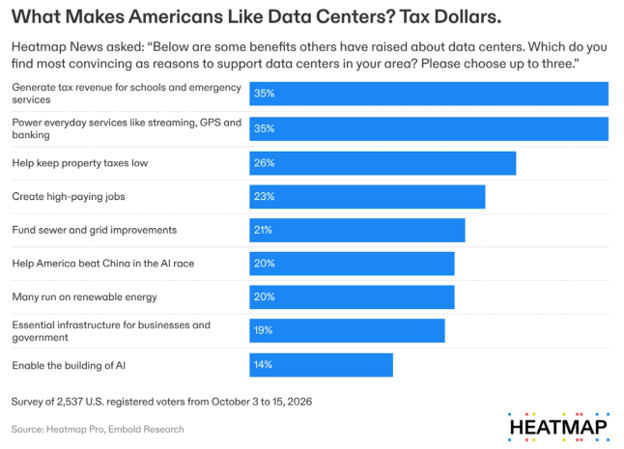
A common refrain around the data center industry in the run-up to the elections is that political action that geared up in response to rising opposition to data centers will subside following the midterms. We doubt this will be the case. Data centers are at the center of close races across states, and many candidates are staking their political reputations on dealing with the concerns voters are voicing: 16 states have a candidate for governor seeking a data center moratorium; Governor Shapiro established strict rules for data centers via executive order in Pennsylvania in the lead-up to the election, and whether the legislature takes further action is expected to depend on Tuesday’s results; and Georgia’s Public Service Commission, where rates have risen more than 40% since 2022, could switch partisan control if Democrats win both seats. While the country is historically polarized, opposition to data centers is a rare point of consensus. Since the beginning of the year, both parties’ candidates have been jockeying to be more anti–data center than the other side. Despite continued support from the White House, the mood across the political spectrum is dour toward anyone wanting to build compute. One of the most high-profile examples is Texas, where Governor Abbott’s pause remains in place but instead of relief, the midterms set the scene for the state’s 2027 legislative session. While the tenor of headlines is likely to soften post-election, we expect states to continue to raise standards on data centers rather than ease them. There are opportunities for developers who listen to communities: a growing body of polling, alongside on-the-ground experience, shows that opposition is more movable than recent media coverage implies (Heatmap News).
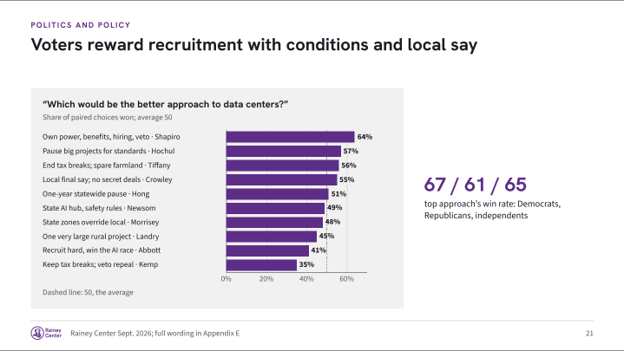
As the chart below shows, voters are not unmovable (Rainey Center, prepared for Jefferies). Each respondent sees two options at a time, drawn from the full list. For example, they might see the Shapiro approach against the Abbott approach and be asked “Which would be the better approach to data centers?” They repeat this for several random pairs.
State and local decisions will matter more to developers and investors than federal ones for the next few years. Looking just at energy, decisions impacting how the grid expands to meet rising electricity demand fall under state jurisdiction. State energy policies influence the generation mix and direct investment in grid infrastructure.
States also offer a more direct path for policy momentum to translate into law, and this election cycle is showcasing plenty of motivated states. A new suite of policies is needed for the current energy era. The old playbook of RPS policies and direct incentives doesn’t fit today’s grid or affordability challenges, but it does illustrate the impact that a few leading states can have in introducing model policies that proliferate across the country. The lack of federal leadership on these issues will increase pressure for state leadership. It’s unclear whether bipartisan opposition to data centers will lead to policy consensus. With a historically unpopular president, a Republican majority in Congress that is almost certain to shrink, and likely fewer Republican-controlled statehouses, decisions about how data centers get developed, built, and energized will be made by a more diffuse set of policymakers across the country. That makes it harder to imagine consistent rules from state to state.
From November 4, presidential hopefuls for 2028 will begin to sharpen their messages. Communities made clear in the run-up to the midterms that they expect more from data center developers, and those expectations will not fade. A plurality of Americans believe the country should keep building data centers but should “require stronger protections for electricity customers and nearby communities” (Heatmap News). Without federal action on AI or data center regulation, the community rulebook will be created bottom-up from local pressure and state action, with what will likely be a patchwork of regulations through voluntary standards set by the industry and NGOs. Across our policy partners and trade associations, attention is turning to identifying priority states and drafting model policy for 2027.

Neighbourhood watch
Last month we cited SemiAnalysis data showing only 1.2GW of capacity actually trapped under local moratoria. That could be read as a sign that local opposition is overstated. Heatmap’s numbers suggest otherwise: more than $260 billion in data center projects have been canceled in 2026 following sustained local opposition, about half of it in the third quarter alone. Part of the gap comes down to different tracking methodologies. But methodology aside, both can be true. The point isn’t whether the canceled projects were real; it’s that many of them would have found demand had they been built. Without today’s local constraints, even middling developers could have gotten projects over the line, and stalled projects could have moved from weaker developers to stronger ones. That consolidation route is now much harder.
What we're reading
2026 thread of solar-and-storage opinions (Jenny Chase). One line brings back very fond memories of working for, and later with, Jenny: “Batteries are going to grow like crazy for the next five years or so and BNEF’s forecasting team are being cowards about it.”
EPRI’s updated incident database shows global lithium-ion BESS failure rates, measured per GWh deployed, fell 98% from 2018 to 2025 and were cut in half between 2024 and 2025 alone. Annual failure rates now sit between 0.04% and 0.14%, on par with the oil-filled transformers (0.1%) that have hung on utility poles for a century without a moratorium (Bantam, Utility Dive)
The Market’s AI Faith Test (David Cahn)
The Development Capital Gap in Data Centers and Powered Land (XIP)
The Cost of Moving Too Slowly on Load Flex (Luminary Strategies)
The Price of Flexibility (Compute Heat Rate)
A single machine: Overcoming the barriers to grid transformation (Tapestry)
Why AI companies are paying a premium to go off the grid, and what this costs the rest of us (Energy Institute at Haas)
More newsletters
October 2026 Newsletter
In Eric Cross's The Tailor and Ansty, Timothy Buckley describes a collop as "an old count for the carrying power of land", noting that it was land deemed capable of supporting the grazing of one cow, six sheep, or twelve goats. He saw it as a better measure of land value than the acre, noting that a holding of 4,000 acres of barren land would barely produce enough to feed four cattle. Powered land sites warrant a similar approach: two sites with almost identical acreage, headline megawatts, and energization dates can have dramatically different carrying power.
Read moreSeptember 2026 Newsletter
Data center financing remains widely available, but it is getting more selective, more conditional, and more expensive. Investors and lenders are also increasingly aware that despite the diversity of projects across the country, the revenues and credit flow back to a handful of companies. The dance between developers, customers, investors and lenders increasingly resembles an Eightsome Reel: energetic, seemingly chaotic but actually highly structured and unforgiving of a missed step. The financial markets are reacting to several dynamics. Many of the power projects being built to serve that demand are first of a kind, whether in structure, scale or technology; AI demand is explosive but close to impossible to forecast; government yields are climbing, with the 10-year Treasury briefly rising to 5.34%, its highest since 2002; and hyperscaler capex, forecast to exceed $1 trillion next year, is testing the depth of debt and equity markets. Unlike the reel, whose steps have changed little in a century, the form and fundamentals of data center financing are much more fluid. As Benedict Evans put it: the most dangerous words in investing are “this time is different”; the seven most dangerous words are “people always say ‘this time is different.’ It’s always different."
Read moreAugust 2026 Newsletter
Recent reporting on equipment failures and power interruptions at several early off-grid data center projects highlights genuine technical and financial risks. Furthermore, no one has enough operating history to understand how the equipment will hold up. This suggests that things will get harder before they get easier. This is not, though, a blanket argument against on-site power. It is an argument for engineering these systems differently, for engaging with a community differently.
Read more