

Our read
On August 3, Governor Abbott directed the Public Utility Commission of Texas (PUCT) and the Electric Reliability Council of Texas (ERCOT) to conduct an audit of all data centers advancing through ERCOT’s interconnection process. A common market reaction was Abbott had hammered another nail in the coffin of grid-connected data centers (NPM). Indeed, several data center operators we spoke to confirmed that they would favor behind-the-meter configurations in response to recent developments.
There’s more to this than meets the eye though. As my former Bloomberg colleague aptly put it, “It’s a beguiling argument, but half-baked […] Withdrawing from the grid would […] magnify the disconnect between these AI factories and the local communities in which they land.” (Bloomberg). Politicians are scrambling to react here because allowing data centers to proceed unchecked has become a political albatross. Going off-grid does not change this. Indeed, onsite gas projects typically receive even greater community pushback, even in gas friendly states. VoltaGrid withdrew its permit for fourteen gas generators serving a Vantage campus in Quincy, Washington, the friendliest data center town in America, before the comment period closed. Clearway canceled a Nevada solar-to-gas swap after one press report. xAI required a Department of Justice intervention on the grounds of national security to secure a reprieve at its Colossus Project.
Growing more cloistered from the community may prove to be a dead end, especially as the resources at stake are ones people widely regard as public. Community opposition will lead to more cancellations, for grid connected or off-grid projects, unless developers change tack. Common methods for stalling or canceling projects include moratoria and zoning freezes, permit hearings and comment campaigns, utility rate-case interventions, litigation and state-wide policy (Occam’s Edge). This is what opposition looks like before the first shovel hits the ground. A more productive and lasting relationship between the data center and the community is necessary.
More speed, less haste
The rush to build data centers across the country has overwhelmed system operators and utilities alike. In ERCOT, the real issue is not Abbott’s recent directive but an unworkable imbalance between announced demand and what the market can sustain. The operator could not expect to absorb ≈200GW of “eligible” load, let alone a queue that now sits at 500GW, on a ≈90GW system. New rules though don’t mean no development and clear rules and process is likely preferable to regulatory ambiguity.
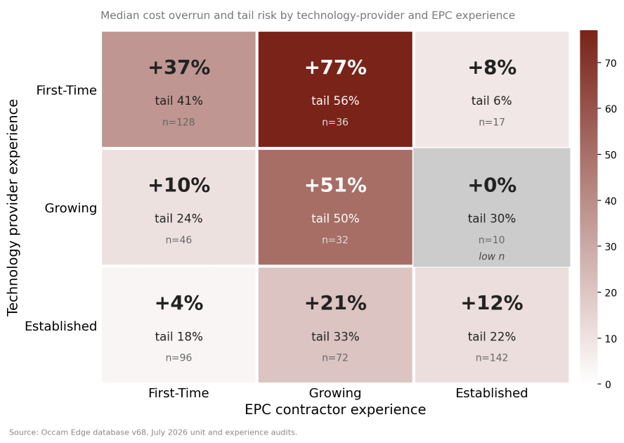
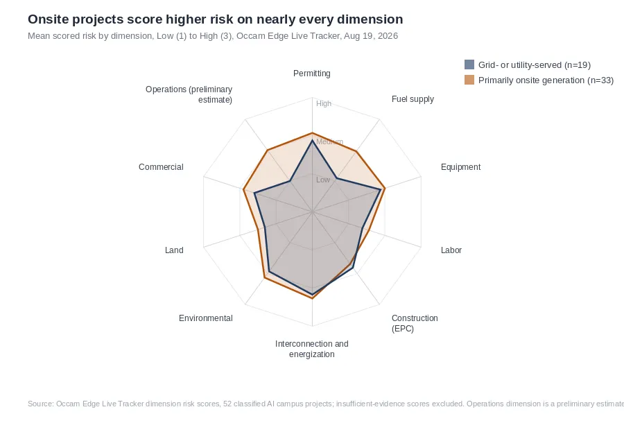
The rush to build is also troubling many projects (WSJ). The data supports the anecdotal evidence: analysis from Occam’s Edge showed that first-time technology providers have a median cost overrun of roughly +32% against +10% for established technology providers. First-time technology providers show a 2 in 5 probability of exceeding a 50% cost overrun against roughly 1 in 4 for established technology providers. Onsite projects score higher risk on nearly every dimension.
An engineering challenge
Recent reporting on equipment failures and power interruptions at several early off-grid data center projects highlights genuine technical and financial risks. Furthermore, no one has enough operating history to understand how the equipment will hold up (Eradeh). This suggests that things will get harder before they get easier. This is not, though, a blanket argument against on-site power. It is an argument for engineering these systems differently, for engaging with a community differently.
AI data centers can impose unusually large and rapid changes in power demand. If those load characteristics are not understood before equipment is selected and the system is designed, the resulting stress can cause instability, accelerated degradation and, in extreme cases, major equipment failures.
On these projects we model the customer’s actual load characteristics, including the size, speed and frequency of load changes, before finalizing system architecture and operating philosophy. The development program includes the advanced electrical studies, ramp-rate analysis and mechanical assessments needed to understand how the generation fleet will respond to rapid AI load changes. These findings inform equipment configuration, controls, operating limits, storage requirements and protection settings, and more.
Large-scale on-site power is not without risk. These are complex systems serving loads with limited operating history, and the consequences of poor performance can be significant. But these risks can be materially reduced through disciplined sequencing, independent oversight and early investment in engineering. That approach may require more work before construction, but it is substantially less expensive than equipment failure, prolonged downtime or redesigning an operating facility.
Neighbourhood watch
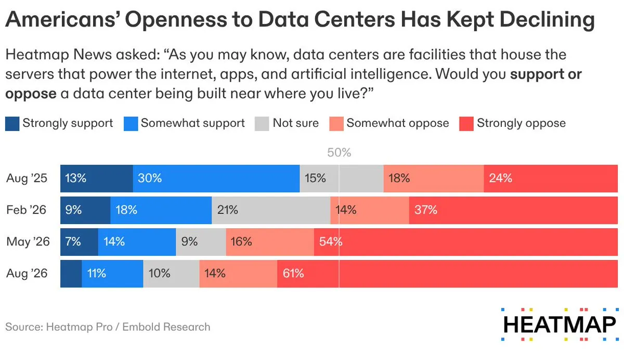
Sentiment has collapsed, in polling from several independent shops. Gallup, fielding March 2 to 18, 2026, found 71 percent of US adults oppose a data center in their local area, 48 percent strongly. For scale, only 53 percent oppose a nuclear plant nearby. Heatmap and Embold Research found 75 percent of registered voters opposed.
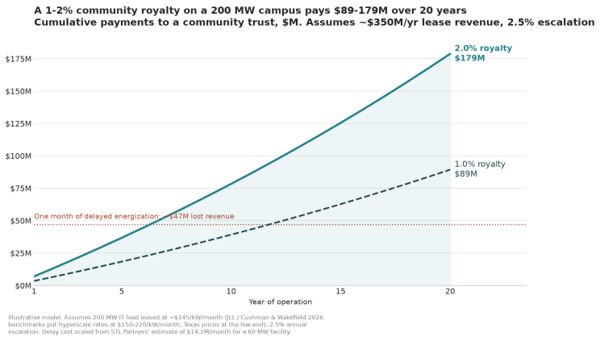
Effective community engagement comes in many shapes and sizes but even today, the conversation too often takes place in a vacuum. This is not the first time we have built a new class of infrastructure, as one helpful addition to the discourse this month highlights. Oil and gas and other extractive-industry developers have been negotiating with communities and policy makers for a century and have developed productive policy strategies and community engagement priorities. These are not universally popular, but we can learn from them. “Host communities supply the three inputs AI cannot virtualize: land, power, and water. Most of them are still being paid in one-time benefits […] Texas already has a deal structure for exactly this situation: the royalty. The General Land Office collects 20 to 25 percent of gross production value on oil and gas from state lands. Those royalties sent $1.4 billion to the Permanent School Fund in FY2025 alone, per the Texas Oil & Gas Association, and built it into a $66.5 billion endowment, the largest educational endowment in the country. Private mineral owners negotiate the same instrument at 12.5 to 25 percent. Nobody calls it anti-business.” (Shreyas Shah)
A second adaptation is the concept of a community energy portfolio standard (WattCarbon). “Every data center that wants to begin operating must track its power consumption, even if it is self-generating its own power. In order to receive permission to operate, it must show that it is procuring a minimum percentage of its energy from the surrounding community (the eligibility radius should allow for enough capacity).”
A domestic drama
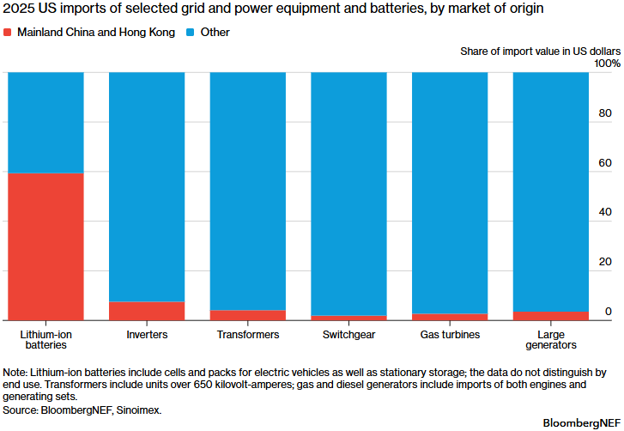
The rush to build has also strained already stretched power equipment supply chains, with lead times lengthening for key items such as transformers. Restrictive trade policy and mounting grid-security concerns are making it worse. President Trump issued an emergency executive order on August 26 that bans “any acquisition, importation, transfer, or installation” of foreign-produced transformers, inverters, circuit breakers and other electrical equipment that can be used to sabotage US power plants and the electricity grid. Most of the 24 countries listed in the order are not typically suppliers for the power industry, but China is (Norton Rose Fulbright). The Trump administration is also weighing a new round of sweeping tariffs on semiconductors, according to reporting from PoliticoPro. U.S. trade policy remains a mess and the complexity of navigating the multiple sets of rules and definitions is an industry-wide challenge.
What we're reading
The Journey to Build for AI: Paper 1 Release (Luminary Strategies)
Grid 2.0 Taskforce request for comments (G2TF)
Charts of the Week: Winds of Thematic Change (A16z). “Data Centers Are A Blue Collar Bonanza”
Armageddon by Anthropomorphism (Hardcore Software)
More newsletters
September 2026 Newsletter
Data center financing remains widely available, but it is getting more selective, more conditional, and more expensive. Investors and lenders are also increasingly aware that despite the diversity of projects across the country, the revenues and credit flow back to a handful of companies. The dance between developers, customers, investors and lenders increasingly resembles an Eightsome Reel: energetic, seemingly chaotic but actually highly structured and unforgiving of a missed step. The financial markets are reacting to several dynamics. Many of the power projects being built to serve that demand are first of a kind, whether in structure, scale or technology; AI demand is explosive but close to impossible to forecast; government yields are climbing, with the 10-year Treasury briefly rising to 5.34%, its highest since 2002; and hyperscaler capex, forecast to exceed $1 trillion next year, is testing the depth of debt and equity markets. Unlike the reel, whose steps have changed little in a century, the form and fundamentals of data center financing are much more fluid. As Benedict Evans put it: the most dangerous words in investing are “this time is different”; the seven most dangerous words are “people always say ‘this time is different.’ It’s always different."
Read moreAugust 2026 Newsletter
Recent reporting on equipment failures and power interruptions at several early off-grid data center projects highlights genuine technical and financial risks. Furthermore, no one has enough operating history to understand how the equipment will hold up. This suggests that things will get harder before they get easier. This is not, though, a blanket argument against on-site power. It is an argument for engineering these systems differently, for engaging with a community differently.
Read moreJuly 2026 Newsletter
The data center industry continues to surprise both in terms of how quickly the status quo can change, and how resolutely many stakeholders assume the current status quo is now fixed. Eighteen months ago, fully islanded projects were more speculative than real, hyperscalers’ decarbonization bona fides were still mostly intact, and permitting was largely a formality if you followed process. Each looked settled right up until it wasn't, and expecting stability now is a curious leap.
Read more