

Nothing is firm
The data center industry continues to surprise both in terms of how quickly the status quo can change, and how resolutely many stakeholders assume the current status quo is now fixed. Eighteen months ago, fully islanded projects were more speculative than real, hyperscalers’ decarbonization bona fides were still mostly intact, and permitting was largely a formality if you followed process. Each looked settled right up until it wasn’t, and expecting stability now is a curious leap. While sometimes exasperating, we can take comfort in how commonplace this experience is in dynamic situations. A recent FT article on Volkswagen’s woes framed this around organizational theorist Karl Weick’s approach to sense-making. Weick once wrote, “no sooner do people make sense of the world than that sense is out of date”. Navigating these fast-evolving situations requires neither extreme confidence nor extreme caution, but “curiosity, openness and complex sensing.”
With that in mind, my colleagues and I are frequently assessing what is the ephemera of an unstable debate and what are signals of larger potential disruption. Is demand as durable as the headline numbers suggest, will the cost of serving it remain bearable, and will the rules and consent a project was underwritten against still be there at COD? Some of these risks can only be mitigated through diversification across product offering, geography and customer base, while others are governed by the principle of the scarcest resource and require disciplined diligence and underwriting.
At a high level, Generate offers two products in the data center market. Building off a decade of owning and operating distributed thermal assets, we provide on-site power solutions. We also build and finance projects that either raise the firm grid limit or use batteries and often generation to allow a grid-connected data center to consume operational headroom above its firm limit. Arushi Sharma Frank has a useful primer on the differences here (Luminary Strategies).
Record demand, unclear staying power
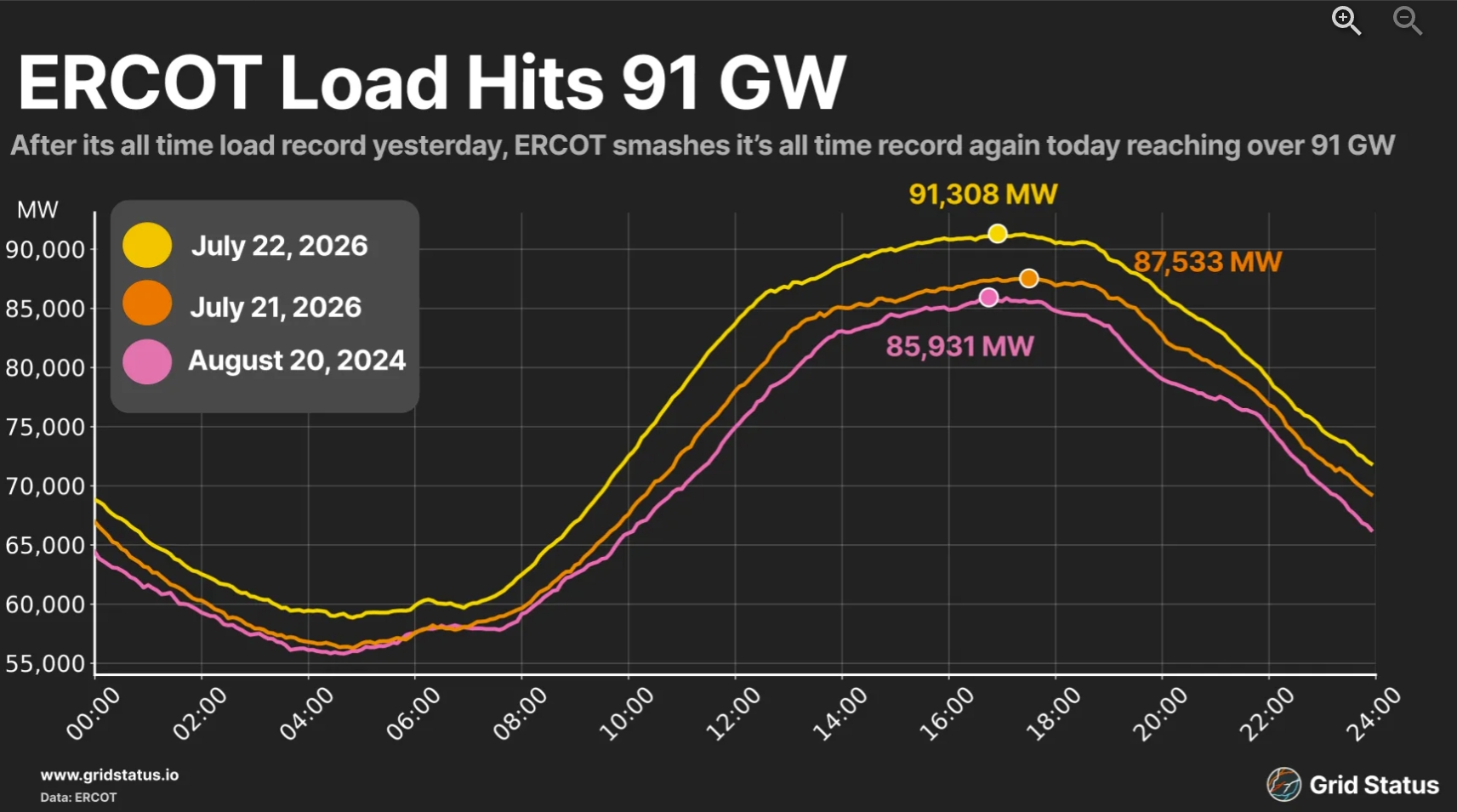
Earlier in July ERCOT load reached 91.3GW, setting a record for instantaneous load that is more than 5GW above the previous high-water mark (Grid Status). There were also new all-time highs for battery discharge, at 11.9 GW, and solar generation, at 34.6 GW. Elsewhere, PJM relied on emergency conservation measures to keep electricity demand from topping the all-time record of 165.6GW that was set in 2006. Instantaneous load instead maxed out at approximately 162.7GW under a heatwave that spanned much of the eastern U.S. (Reuters).
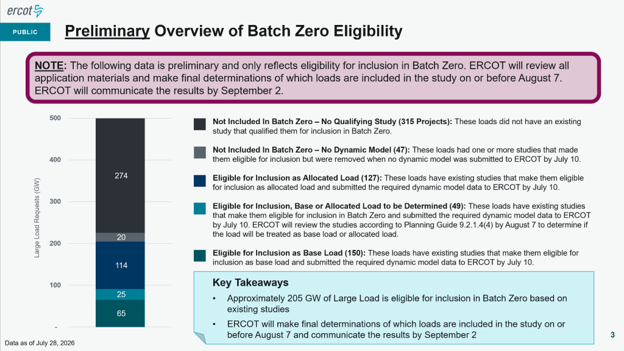
Data centers are not the only contributor here, but they make up some 90% of the large load queue, and emergency measures and dramatic changes to how we build, finance, and deliver power wouldn’t be necessary without them. Since ERCOT’s Batch Zero window closed on July 24 the operator has confirmed approximately 205GW of large load is eligible for inclusion (ERCOT). The actual load that will be included in the study will be considerably smaller than this as new requirements, such as a $50,000/MW interconnection deposit, whittle it down. But even a heavily discounted 205 GW is dramatic next to a system that just set its all-time peak at roughly 91 GW.
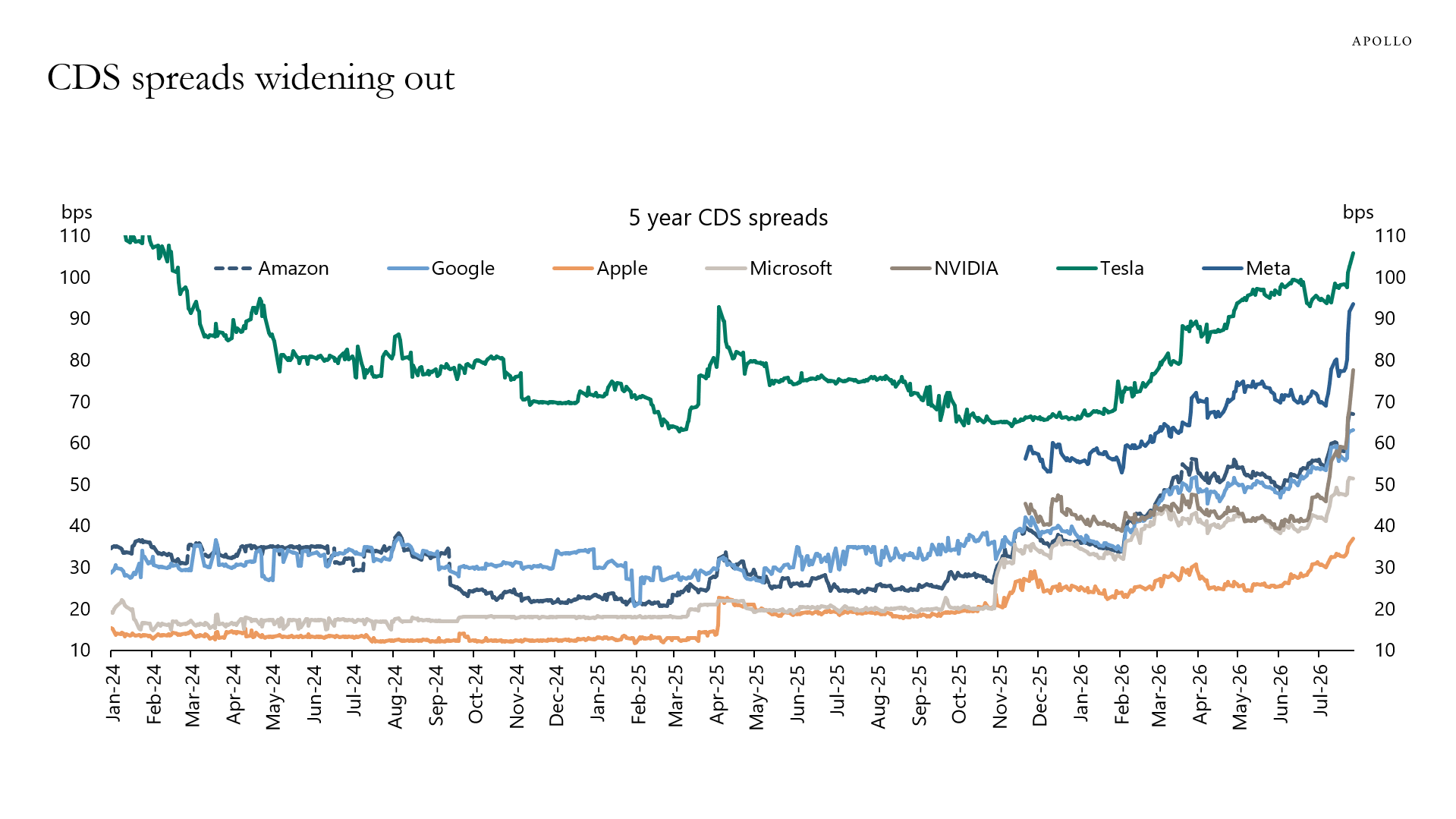
Much of the activity in the U.S. is ultimately backstopped by a handful of U.S. hyperscalers and frontier labs. The conventional wisdom of six months ago was that the largess of the hyperscalers and their historically strong cash position would allow them to pay anything for this capacity. This commentary was more often made by those not in direct negotiations with the firms themselves, but it contained a kernel of truth. This is now being challenged as free cash flow goes negative and data center firms look to the markets for capital. As the buildout is increasingly funded by debt, hyperscaler spreads are widening and the question becomes whether the all-in-yield rises to a level that constrains the capex cycle (The Daily Spark).
The required revenue per GW of CapEX is also increasing due to rising construction and labor costs, and higher financing costs. In September 2023, David Cahn framed the CapEx concerns as AI’s $200B question and this month he updated it to AI’s $1.5T question.
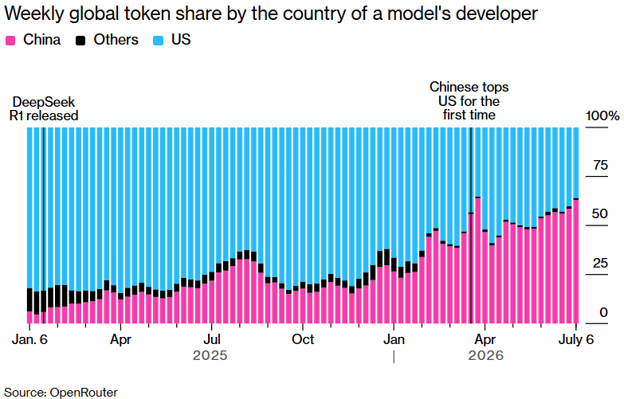
Increasing competition, especially from Chinese open source models, further complicate the ability to sustain productive distributed economic impact. Earlier this year, China topped the weekly global token share, which if the trend continues, would put further pressure on U.S. firms’ economics. Questions of open and closed models and security considerations have further upended where their data capacity will be needed and who will pay for it.
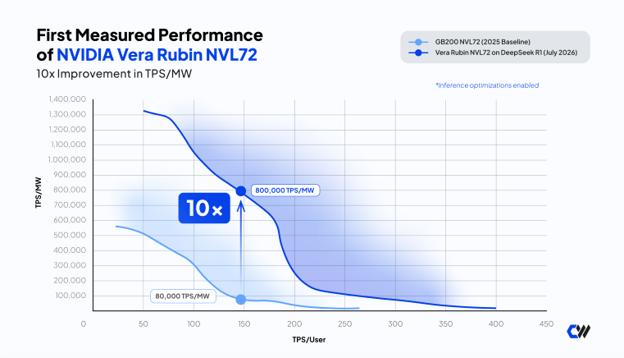
On the power side, improved efficiency could further dent demand. In a study published earlier in June, CoreWeave shows a 10x improvement of tokens throughput per megawatt for the Vera Rubin NVL72 versus Blackwell (CoreWeave).
In short, there are too many variables right now for anyone to know the answer on the scale and pace of future data center demand. As Benedict Evans wrote, “Part of the concept of the ‘S Curve’ is that there’s a stage early in the emergence of a new technology where it’s clear that this is going to be huge but nothing else is clear at all”
Rising costs
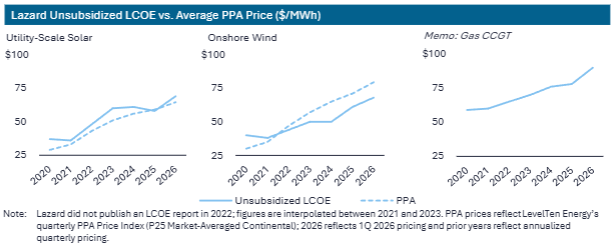
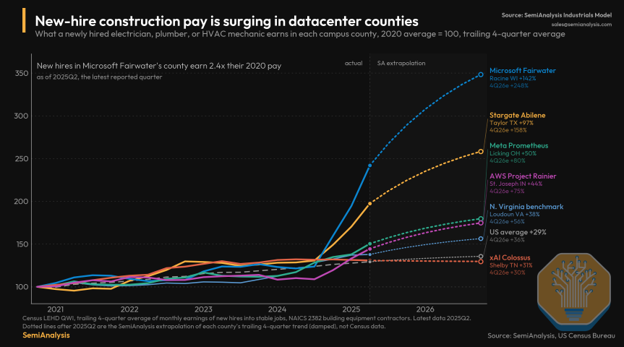
A host of headwinds and increasing competition for equipment, land and capital are pushing up the cost of developing data centers in the US. Generation costs across the board are rising (Lazard 2026 LCOE+ Report), and prices for power and distribution transformers have almost doubled post-pandemic (The Financial Times). Powered land sites in certain locations are transacting for millions of dollars per acre, and new-hire construction pay has soared in counties with data centers (SemiAnalysis). The capacity of buyers to absorb these rising costs is finite and uncompetitive projects will often not proceed.
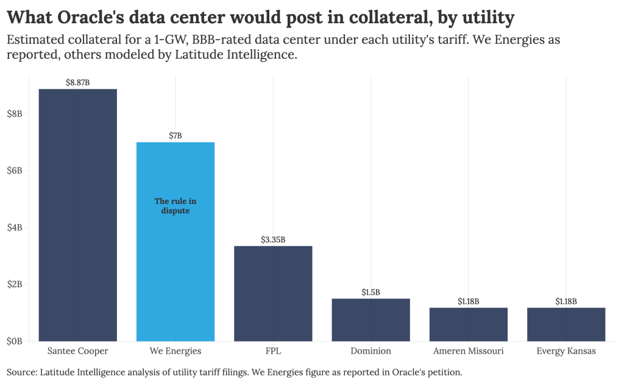
As credit ratings deteriorate, and unease from regulators about cost allocation increases, collateral requirements are also increasing. In Wisconsin, Oracle is seeking to overturn a Public Service Commission order that could result in the hyperscaler having to post security of more than $100 million a year against a collateral pool of over $7 billion (Latitude Media). This was triggered by S&P downgrading Oracle’s rating to BBB.
Capital sequencing
Many opportunities require material upfront capital for equipment procurement or IX deposits ahead of fully de-risking a project. This creates a capital bottleneck for many developers. Pre-NTP capital is significantly more constrained, and costly, than the financing available at later stages. This further tightens with each commitment a developer takes on, since procurement obligations are often underwritten against the sponsor’s balance sheet. Many projects fail at this stage: we see slots for on-site power equipment, for instance, open up fairly regularly as previous buyers are no longer able to proceed. Developers’ inability to secure sufficient capital for IX deposits for Batch Zero will similarly lead to the cancellation or delay of many eligible projects.
Many cooks, diverging preferences
Many projects, regardless of the developer, ultimately require hyperscaler offtake which makes many contract negotiations tri-party as opposed to bilateral. A rapidly evolving status quo and the speed at which the market and hyperscaler preferences or priorities are changing, and diverging, further complicates this. Parties across the value chain have less certainty regarding the attractiveness of their end-state project, even assuming sound execution. This narrows the pool of potential buyers the data center operators can sell any given project to.
Regulatory Uncertainty
Market structures that have been in place for years, often decades, are being upended. These come in various flavors, with some reforms focused on data centers whereas others are market-wide but catalyzed by the surge in large load growth. As an example of the latter, the range of potential outcomes for PJM is extraordinary. The capacity market continues to hit the $325/MW-day price cap while failing to incentivize new capacity to come online, with the 2028-29 delivery year falling 6.8GW short of the target. Various alternative proposals are under consideration alongside governance and stakeholder reforms at PJM itself, and several states are openly talking about leaving the market (Utility Dive). Activity across other ISOs is perhaps less dramatic but change is afoot across the country.
Then there are specific reforms aimed at offering pathways for large loads to connect to the grid quickly and affordably. Some of the most interesting of these mechanisms are now live in ERCOT and SPP but the details of each tariff vary by market and parts remain in development as utilities work on implementation. Ensuring these are operationally workable and financeable is critical, as is customer education. This is a core focus of ours, especially since the understanding of the nuance within each of these approaches varies a lot across potential tenants.
Even if you’re not looking to benefit from taking curtailment, it might be coming for you anyway. Late in July, the Public Utility Commission of Texas signed the final order in Docket 59220, in a test of SB6’s colocation framework. The order requires the site’s full co-located load to curtail when ERCOT instructs during a grid emergency, even though the paired net-metered wind facility is roughly half the size (interconnection.fyi). This ruling changes the cost-benefit analysis for data centers co-locating with existing generators, as curtailment exposure is not necessarily capped at the size of the generator, and that curtailment is uncompensated.
Elsewhere, PJM announced plans to require large loads that do not bring their own capacity to accept mandatory curtailment during periods of insufficient resource adequacy beginning in June 2027. PJM will create a registry of data centers and other large energy users to track location, service area and whether they have their own power supply, to support this proposal (PoliticoPro).
Communities partnerships
One of the sharpest changes over the last 12 months has been the swing in community sentiment relating to data centers. Although the change is widely known, many data center developers continue to overestimate the strength of their hands, buoyed by ordinances and statutes that suggest permitting and rezoning are formalities if process is followed properly. The reality, as anyone who cut their teeth building renewables generation knows, is that treating community engagement as an afterthought bodes poorly for the project’s success. Interminable delays and challenges can scupper a project even if the path to permit is technically still feasible, or even assured (The Edge). Rising community opposition may also lead to a growing proportion of smaller data centers that are easier to permit, less politically contentious, and better aligned with local energy resources.
Governor Hochul of New York signed an executive order on July 14 temporarily halting state environmental permitting for new data centers above 50MW. The executive order was though in reaction to a pending bill, and is both narrower and reversible. The correct takeaway here is not that state moratoriums will be enacted across the country but rather that guardrails and expectations on new data centers are increasing. This is a better outcome for all. As Washington state Rep. April Berg recently stated, “When you’re talking about moratoriums and you’re talking about bans, you are taking yourself away from the table as a policymaker, and that’s not OK”. This sentiment is also echoed by many in the environmental justice community. The posture of these organisations varies: a few are resolutely anti-data center but many focus on requiring that data centers meet certain conditions as defined by the community. Organizations such as the Better Data Center Project and Fair Shake work to ensure that communities have a voice in the process and understand how to participate effectively.
Effective community engagement in this environment recognizes that public sentiment, political forces, and project-specific dynamics cannot be disentangled, but each requires a distinct and targeted strategy. It likely requires a local and a national approach, disciplined selection criteria before engaging a project, early evaluation of political, regulatory, and community sentiment risks and a willingness to say no to overly risky projects. It requires a realization that communities are now critical counterparties that can’t be taken for granted or placated with simple and surface level solutions. It must address what the community is actually annoyed about, to be transparent and early, and to present a broader package. To do this, the contents of any engagement will differ and likely include multiple offerings in addition to commitments around noise, water, setbacks, building design (WSJ) and the like.
You can layer on direct payments or the actual installation of clean power to reduce consumers’ electricity bills. For example, on July 7 Governor Sherrill signed the Data Center Fair Share bill that allows data centers to pay for households to install heat pumps, rooftop solar and batteries (Canary Media). Interestingly, “A study from the Center for Net Zero tested how people respond to different data center deals. A financial promise, lower taxes or a community fund, drew only about 20% support. Put a battery in the garage and solar on the roof, and support climbed to roughly 65%. People do not trust a one-time payment or future tax refund that can quietly shrink. They trust a physical asset they can see and use.” (Energy Empire)
What we're reading
The commercial launch of the Transition Acceleration Framework (TAF) developed by the Rhodium Group, CalSTRS and Generate. The TAF helps direct capital to where it can most effectively accelerate the global energy transition.
Will AI solve or exacerbate climate change (Phil Verey)
Energy Impact Partners annual trends in technology and energy write-up (Steel for Fuel).
A new risk framework for Chinese technology products and investments (Brookings). A useful addition to the discourse following the recent “inverter ban”.
The 10 largest US stocks represent 40% of the S&P 500 market cap. Even if it has risen from just 17% as recently as 2015, it is still at the lower end globally (Eye on the Market).
Exponential View State of the AI Economy
AI is getting too expensive (Ed Zitron)
Did you know data markets have spot prices too? (Farhad Billimoria)
Wherever data centers go, batteries will follow (Modo)
Dark gigawatts: Undisclosed operational risk in the AI power buildout. (Occam’s Edge)
A survey of 6,500 voters across five states on data centers (Milltown Partners).
The Texas Public Utility Commission voted to require data centers and other large loads to stay online during temporary grid disturbances. US regulators on July 16 ordered NERC to file standards for computational loads by Dec. 31 (Elevate Energy). Lynne Kiesling argues that the fitting lens here is a Coasean bargain. “Ronald Coase’s insight was that when two parties’ activities impose costs on each other, the question isn’t who’s at fault, it’s how to assign rights so the two sides can find the least-cost way through the problem together (The Knowledge Problem).
Governance of Multi-State Electricity Markets for the 21st Century (Abe Silverman). As electricity prices become a growing political issue, states are likely to play a much larger role in shaping how regional electricity markets operate. The paper proposes new ways that states could work together to have more influence over grid operators.
WattCarbon’s GridSolver tool looks at how peaky local demand is and how concentrated wholesale congestion is. It then maps this to buildings across the country to identify what type of distributed energy resource is most effective in each location (WattCarbon)
More newsletters
August 2026 Newsletter
Recent reporting on equipment failures and power interruptions at several early off-grid data center projects highlights genuine technical and financial risks. Furthermore, no one has enough operating history to understand how the equipment will hold up. This suggests that things will get harder before they get easier. This is not, though, a blanket argument against on-site power. It is an argument for engineering these systems differently, for engaging with a community differently.
Read moreJuly 2026 Newsletter
The data center industry continues to surprise both in terms of how quickly the status quo can change, and how resolutely many stakeholders assume the current status quo is now fixed. Eighteen months ago, fully islanded projects were more speculative than real, hyperscalers’ decarbonization bona fides were still mostly intact, and permitting was largely a formality if you followed process. Each looked settled right up until it wasn't, and expecting stability now is a curious leap.
Read moreJune 2026 Newsletter - AGM Edition
We hope to see many of you at our AGM this coming week, but in the meantime, here is the latest on what’s happening at the nexus of AI demand and energy. Both Generate and this newsletter have come a long way since our first post in September 2024. Generate is now focused on what our CEO David Crane recently described as “the single defining factor in the future of our industry – AI demand is accelerating faster than the infrastructure needed to support it.”
Read more