

Expert View
21 Sep 2026
A Tale of Two Margins
Expert View By David Crane
In one corner, there are the trillion-dollar tech companies, trying to impose their all-powerful and all-knowing type of compute on us through the medium of gargantuan big box data centers; and in the other corner, sit the hard pressed American public, numerous to be sure, but hopelessly out resourced. The issues are presented as both binary and nihilistic. Tech wins; we lose. We win, (American) tech loses, China gains and we lose anyway. But the AI data center phenomenon, through its effect on energy costs and availability, does not just affect American energy consumers who are watching their monthly household energy bill rise, it is having a big and growing impact on American business and industry.
For more than a decade, Generate has helped customers manage their power efficiently and cheaply: the companies that process our food, produce our chemicals, manufacture our products, and educate our kids. These businesses were the grid’s largest customers long before anyone said the word hyperscaler. Over the past two years, our conversations with those customers have changed. In addition to prioritizing cost savings as power prices rise, they are being forced to navigate new rules to gain access to the power they need and compete with loads that seemed unfathomable when they built and grew their businesses.
Until a few years ago, these businesses and institutions we served – manufacturers, food processors, cold storage operators, banks, schools and hospitals – were the big kids on the energy block. The grid was planned around their needs, and the American economy still depends on them. Manufacturing adds $3.0 trillion of value every year, about 9 percent of US output, and employs 12.6 million people, more than the population of Ohio. Industrial facilities together use about a quarter of the country’s electricity, several times what data centers consumed as recently as 2023. These companies still need large amounts of power and it is in the country’s best interest to build policies and provide capital that give them access to it.
Reuters reported in July on what that change looks like from inside one of these companies. Belden Brick, a family brickmaker in Sugarcreek, Ohio, now in its fourth generation, watched a single line on its power bill jump from about $1,600 a month to about $12,000. That line is the capacity charge, the fee that pays generators to be available on the grid’s most stressed days. The company raised brick prices 4 percent and profits still fell. In the same story, Plaskolite, an acrylics manufacturer with plants in Ohio and Pennsylvania, reported its annual capacity charges rising from $200,000 to $1.2 million, and Tosoh SMD, an electronics materials maker in Grove City, Ohio, described weighing a move to overnight production in order to be able to access cheaper electricity. We hear the same stories from our customers across the country, in food processing, in chemicals, in building materials. Prices are rising, access to more electricity (i.e. load) is getting harder, and companies that are already dealing with the complex nature of building a supply chain, maintaining operational efficiency, serving a customer base, and delivering a commodity are now having to navigate a process that is dynamic, fraught, and not designed to accommodate their needs or their timetable.
Economics and the grid
Emerging rule making in the power sector obscures a fundamental difference between the new mega power consumers and the rest of the loads that drive the economy – margins. Microsoft’s operating margin has run above 40 percent of revenue in recent years. On the other hand, a well-run food processor earns single-digit margins, and large chemical producers spent 2025 fighting through a global downcycle.
The capacity market in PJM shows what that competition costs. PJM is the regional grid operator for 13 states and the District of Columbia and home to the world’s largest concentration of data centers. Each year it runs an auction that secures commitments from power plants to be available at future peak demand, and the cost of those commitments is a major input to how power prices for households and businesses are set. Those same 13 states hold a large share of the country’s manufacturing and food production. Three years ago the auction cleared at $28.92 per megawatt-day. The last three auctions cleared at the cap of $329.17, $333.44, and $325.00. Joseph Bowring, who leads the market’s independent monitor, attributes $6.3 billion of the latest auction’s $16.4 billion cost to data center demand, and nearly half of the $63.6 billion across the last four auctions. That cost has to be borne by someone. Our commercial customers are faced with the choice of passing the cost through to their customers or absorbing the cost through compressing their profit margin. Either can be ruinous to their business.
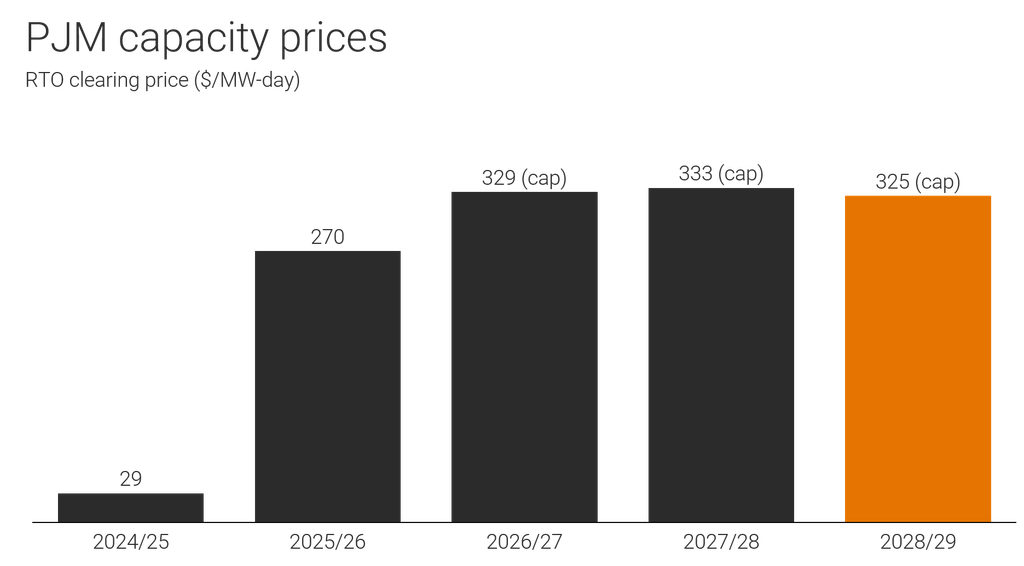
The capacity charge is just the start of the analysis. Wholesale energy still tracks the price of natural gas, which sets the marginal price in most markets. Utilities are recovering the cost of a record capital program through riders added to bills, with investor-owned utilities spending $204.1 billion in 2025 and planning roughly $1.4 trillion through 2030. Customers requesting new service increasingly fund their own upgrades, post collateral, and accept minimum-payment terms that run a decade or longer. The competition for transformers and switchgear adds time and risk, and a delayed energization date carries its own cost.
The margin gap shapes who gets to keep operating and making money when power availability becomes constrained and energy prices rise. Traditional industrial buyers tend to have curtailment thresholds, which is the power price at which making the product stops making money. Aluminum smelters power down around $60 to $80 per megawatt-hour, steel around $80 to $120, chemicals around $100 to $160. A paper circulating this summer estimates that AI workloads remain economical at power prices from roughly $500 per megawatt-hour to over $53,000 for the highest-value services. In other words, data center operations can remain extremely profitable at a price that drives competing demand out of the market and potentially out of business. Plus, a cloud provider can move its workload across the country in milliseconds. A steel mill can’t.
The present opportunity
If rates keep climbing, a company that cut its consumption and locked its prices in early is insulated, with each kilowatt-hour it avoids or generates itself gaining value. If rates level off, that company still spent less on power, gained backup supply, and freed up room to grow.
To achieve those things, companies can do three things.
First, reduce the power intensity of its most used systems. For industrial and institutional facilities, a handful of systems use the most power, kilns and furnaces, motors and compressed air, HVAC and refrigeration. An energy audit identifies which systems have the most savings potential and lead to real cost saving for customers. Efficiency retrofits in lighting, motors, and building systems remain the cheapest power a company can buy. Most commercial and industrial bills include demand charges, fees set by the single highest interval of draw in the month, which can run 30 to 70 percent of the total and which respond to operational changes like staggering equipment starts and shifting flexible loads to off-peak hours.
The second move is to procure power on terms that give the business a predictable price. Long-term power purchase agreements, contracts that fix a price for output from a specific project over a fixed term, are the instrument the hyperscalers use to manage this same risk, and they are available to other large energy buyers. So are fixed-price retail contracts in competitive markets, and demand response programs, in which utilities pay customers for the ability to reduce load during the few hours a year during the comparatively few hours that the grid is strained.
Third is for businesses to produce more of their own power, for the hours when grid power is expensive and the days when it is unreliable or unavailable. On-site solar paired with battery storage now typically reaches commercial customers through the same power purchase agreement structure, with a developer building, owning, and maintaining the system and the customer paying a fixed price for its output with no capital outlay. Batteries shave the peaks that set demand charges while they wait for outages. Facilities that cannot lose power, hospitals above all, can go further with a microgrid, an on-site system that runs connected to the grid in normal times and islands from it during disruptions. Industrial sites with large steam needs can evaluate combined heat and power, on-site systems that generate electricity and useful heat together, where the discipline in the federal EPA’s screening guidance is worth keeping. Fuel cells offer firm power at a premium price, a fit for loads that justify it. None of this is exotic anymore. What large energy buyers need is a partner that understands how to orchestrate a multifaceted approach to efficiency, certainty and resilience.
The responses need not be fully defensive. There are opportunities to build and grow new revenue lines for large scale energy buyers. One way is by co-locating data centers on a C&I facility’s footprint. With resistance rising inexorably to the siting of mega data center campuses, there’ll be more demand for distributed data centers. There is also an opportunity to build and sell power infrastructure back to the grid. C&I customers could host additional battery storage capacity and bid this into Bring Your Own Capacity programs funded by hyperscalers. There is a larger point inside these moves. Sharing resources more effectively can be a boost for these companies’ bottom line, and for the system as whole. The technologies involved grew up serving this class of buyer, and their adoption helps the whole system. A factory that shaves its peak frees capacity for its neighbors. A hospital microgrid takes stress off the grid on its worst days. Efficiency projects at a thousand mid-sized companies do as much for resource adequacy as a new power plant, and they get built faster.
| Strategy | Annual energy savings | Facility-peak reduction | Reduces utility service requirement* | Short-duration continuity | Sustained islanding |
| Efficiency + controls | High | Medium-High | High | None | None |
| Solar PV (alone) | High (daytime) | Low-medium | Low-medium | Low | None alone |
| CHP / firm generation | High | High | High | High | High, fuel limited |
| Battery storage | Shifts, not saves | High | Medium | High (duration-limited) | Limited duration |
| Thermal storage | Medium (thermal) | High (thermal peaks) | Medium | Thermal only | No electric island |
| Flexible load / DR | Low (revenue) | High (event based) | Conditional | None | Extends endurance |
| Microgrid architecture | Depends on asset | Depends on asset | Enables DERs | High | High for defined loads |
Source: Generate, DOE, EPA. Notes: *Any utility-service reduction requires persistent, verified performance and explicit utility recognition — it is never automatic.
Examples from the field
Compressed air
One of the systems an audit usually flags first is compressed air. At two glass manufacturing plants we assessed, these represented close to 40 percent of site electricity. Roughly a third of that energy proved recoverable. Part of it costs nothing: shutting down a compressor that was running in blow-off without delivering usable air, resequencing the remaining units so one carries the base load while another trims, lowering header pressure and repairing leaks. The rest comes from a right-sized redesign — a variable-speed trim compressor that follows demand instead of venting surplus air, a single lower operating pressure in place of two, new compressors sized to measured rather than nameplate load, and the flow, pressure, and power monitoring that lets operators run the plant on actual consumption. One of the two plants had no monitoring at all, so visibility itself was a source of savings. Efficiency like this is still the cheapest power a company can buy, and unlike a new asset it carries almost no technology risk, with the no-cost measures paying back in well under two years.
It also works on two lines of the bill at once. Every kilowatt-hour removed is one no longer exposed to rising energy rates, and the sequencing and controls that smooth the plant’s draw pull down the single highest interval of demand that sets the demand charge, which can often represent 30 to 70 percent of an industrial bill. The value is not uniform across sites: these two plants sit in different power markets, and the one paying more than 40 percent more per kilowatt-hour earns a materially larger return on the identical project. That is the pattern everywhere: the same physical reduction is worth most where prices have climbed fastest.
On-site generation
The same logic scales up to generation. A specialty chemical producer was already making far more high-pressure steam than it turned into power. This came from its boilers, its existing cogeneration units, and the waste heat of on-site sulfuric-acid production. It released the surplus through pressure-reducing valves, throwing the energy away. We put a 43-megawatt condensing steam turbine on that available steam, generating roughly 292 gigawatt-hours a year behind the meter and displacing an equivalent block of utility purchases. The system controls optimize output against the plant’s real-time load and the utility’s real-time price, so it runs hardest in the hours grid power costs the most.
For a chemical maker working through thin margins, that is firm, dispatchable capacity that cuts the two lines under the most pressure together: it lowers energy purchases and, by trimming peak grid draw, the capacity charge. Because the fuel is steam the plant already makes, it carries almost no commodity-price risk; this is recovered energy, not new fuel burned. And it lands without a capital outlay: Generate builds, owns, and operates the turbine, the service fee reconciles each year to metered output, and we hold the technology and performance risk instead of handing over a study.
Why Are These Large Load Consumers NOT Doing this Work Now?
Leaving aside that certain large load customers – Walmart and the hyperscalers themselves – actually have assembled the requisite energy expertise to have greater control over their energy destiny, most companies have not. This is, in part, due to the considerable expertise needed in what is by all accounts a complicated, heavily regulated field. But, in my opinion, it is more likely because in most corporations and businesses, energy, and particularly electricity, procurement is done at the far end of the procurement team. And as I have had a habit of saying, no corporate energy buyer ever got fired for procuring electricity this year for their company in the exact same way that they bought it the previous year. That attitude made sense in an energy era that no longer exists, one defined by immense predictability and glacially slow change. CEOs and business owners can no longer put energy purchase on autopilot. They need to engage and be proactive and creative about and around this new energy dynamic.
A decade of doing this work
The hard part for a large organization is rarely the list of project ideas. The hard part is moving from awareness, to data, to engineering to capital approval to construction to long-term operations across dozens of facilities, while tariffs, technology costs, and tax rules keep shifting under the analysis. A measure that pencils this year may look different in two years, and the right answer differs plant by plant even within one company.
This is the work Generate has done for more than a decade. We start with a customer’s own information, interval meter data, thermal loads, tariffs, asset condition, and expansion plans. We assess each site against what has worked at similar facilities, prioritize the strongest ones, engineer the projects, provide capital and long-term ownership where that helps, coordinate construction, and then operate, maintain, and measure the infrastructure over time, with our returns tied to its performance. Because we own and operate the assets, we carry the technology and performance risk alongside the customer rather than handing over a study and moving on.
The planning costs little and preserves options. Audits, interval data, utility engagement, queue positions, and equipment reservations move faster than any of the infrastructure they unlock. A realistic plan also admits that a behind-the-meter project may need the same switchgear, transformers, or interconnection work it is meant to avoid, which argues for reserving equipment early rather than waiting. Waiting for the constraint to show up in the bill is the expensive choice, because capacity auctions price forecast load years before it energizes, and the cost arrives ahead of the load.
Build for these businesses too
CEOs of the companies and institutions that feed us, fix us, educate us, and entertain us need to get involved, not only in securing commercial solutions that meet their current and future energy needs of their businesses, but also in shaping the energy system now being rebuilt around a new anchor tenant. The rules being drafted for that tenant will govern every business that shares the wires. Regulators writing those rules should draw on the experience of the industries that have carried large load reliably for decades. Energy buyers do not have to wait for that to happen. The ones that move first will spend the next decade glad they did.
More insights
A Tale of Two Margins
Until a few years ago, these businesses and institutions we served - manufacturers, food processors, cold storage operators, banks, schools and hospitals - were the big kids on the energy block. The grid was planned around their needs, and the American economy still depends on them. Today, prices are rising, access to more electricity (i.e. load) is getting harder, and companies that are already dealing with the complex nature of building a supply chain, maintaining operational efficiency, serving a customer base, and delivering a commodity are now having to navigate a process that is dynamic, fraught, and not designed to accommodate their needs or their timetable.
Read moreCommunities Have More Leverage Over the AI Buildout Than They Realize
Communities are skeptical of data centers. They don’t know if they like the underlying technology, they certainly are not feeling the increase in power costs they attribute to this massive build, and they don’t feel like they need to provide tax assistance to the richest companies in the world. The companies needing to build are organizing fast through procurement standards, model legislation, financing structures, and political infrastructure to make sure their interests are represented at every level where decisions get made. Advocates need to help communities benefit from this moment, not be a reflexive “no” and convince communities they have nothing to gain. It isn’t true and it won’t help the people climate, environmental, and community organizing groups claim to represent. Communities that organize with equal seriousness, around what they want from this buildout rather than around whether they want it at all, will end the decade with infrastructure their grandchildren still benefit from. That infrastructure can be clean, affordable, and reliable. Communities that spend the leverage on saying no will get what they always have: whatever is left over after capital sets the terms. Developers that try to undercut productive efforts to build that kind of resilience in communities will end up losing. Both sides need to realize that the relationship can be productive and valuable.
Read moreHigh Stakes at CERAWeek
It is not often - read "never" - that a CEO's decision NOT to attend a conference is a global headline but so it was this weekend when Amin Nasser, the veteran CEO of Saudi Aramco, withdrew from CERAWeek in order to attend to matters closer to home. Mr. Nasser's withdrawal underlines that the focus for all of us still heading to Houston will be on the Straits of Hormuz and its short, medium and long term consequences on gasoline prices. And all the while, the focus on high gasoline prices at CERA this week is likely to obscure the other energy price shock lurking in the shadows which is the inexorable rise of electricity prices across the United States. Unlike gasoline prices, once retail electricity prices rise, they almost never go down.
Read more